The Hippie Trail
The Hippie Trail was the overland route that young Western travelers followed from Europe to India and Nepal between the late 1950s and 1979, across Turkey, Iran, Afghanistan and Pakistan by bus, train and hitched ride. The trail ended in 1979. This page maps the route as it was travelled then, with the dates, fares and names taken from sources of the time, each one linked.
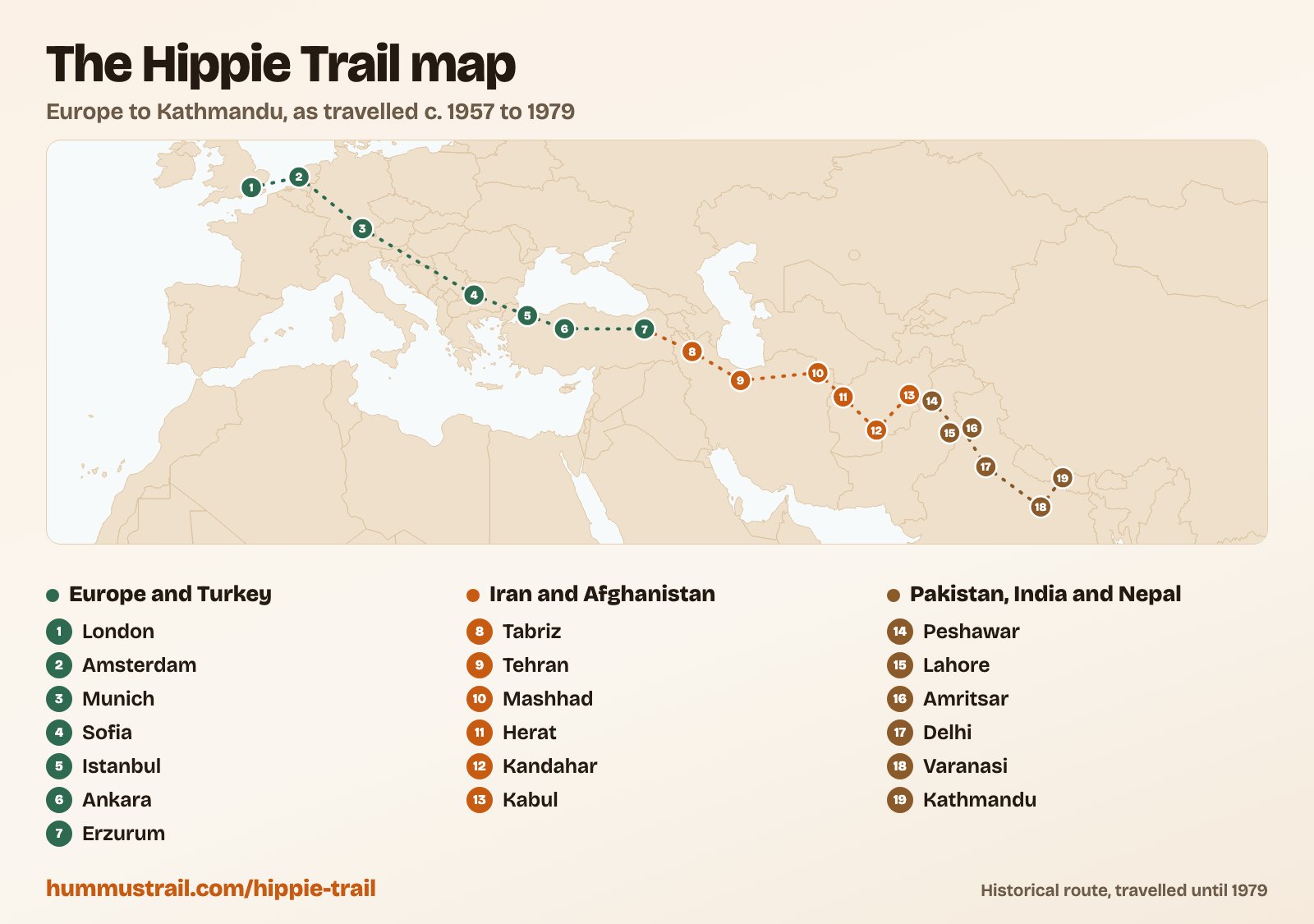
The Hippie Trail map: the main overland line, stop by stop
Europe and Turkey
- London — The usual starting point, and where the first London to Calcutta bus left from in 1957.
- Amsterdam — The other usual start. The "Magic Bus" name came from a booking agency here.
- Munich — On the line the first bus service took across Europe.
- Sofia — Bulgaria was the fastest way through; many went via Yugoslavia or Greece instead.
- Istanbul — Where the routes from Europe met, and where travelers traded news before heading east.
- Ankara — Where the northern and central roads across Turkey rejoined.
- Erzurum — The last big Turkish stop before the Iranian border.
Iran and Afghanistan
- Tabriz — The first Iranian city on the northern line.
- Tehran — The bus hub of the route through Iran.
- Mashhad — The last Iranian city before the Afghan border.
- Herat — The first Afghan city, a few hours by bus from the border.
- Kandahar — On the southern road across Afghanistan.
- Kabul — The main hub in Afghanistan, with Bamiyan the best-known side trip.
Pakistan, India and Nepal
- Peshawar — Pakistan, reached from Kabul over the Khyber Pass.
- Lahore — The last city in Pakistan before the one land crossing into India.
- Amritsar — The first Indian city on the route.
- Delhi — The rail hub for the rest of India.
- Varanasi — Then called Benares, on the rail line toward the Nepal border.
- Kathmandu — The usual end of the overland journey.
What the Hippie Trail was
The Hippie Trail is the name now given to the overland journey from Western Europe to India and Nepal, made mostly by young Western travelers from the late 1950s to the end of the 1970s. It ran through Turkey, Iran, Afghanistan and Pakistan. There was no single official route and no fixed start or end. The usual starting points were London and Amsterdam, the usual end was Kathmandu, and many travelers carried on by air to Southeast Asia and Australia. This page is a history: the trail ended in 1979.
- CNN Travel: The Hippie Trail, an interactive history
- The Independent: The Lonely Planet Journey, the Hippie Trail (November 5, 2011)
- Wikipedia: Hippie trail
The route, in order
Going east, the main line ran as follows. Travelers going home ran it in reverse.
- Europe to Istanbul: from London or Amsterdam across Germany, then through Bulgaria or Yugoslavia, or down through Greece. Istanbul was where the roads from Europe met.
- Turkey: Istanbul, Ankara and Erzurum, then the Iranian border.
- Iran: Tabriz, Tehran and Mashhad.
- Afghanistan: over the border to Herat, south through Kandahar and up to Kabul. Bamiyan was the best-known side trip.
- Pakistan: over the Khyber Pass to Peshawar and on to Lahore, then the one land crossing into India, to Amritsar. The 1973 Lonely Planet guide reported that in 1972 this crossing opened only on Thursday mornings.
- India and Nepal: Delhi, then by rail through Varanasi to the Nepal border and on to Kathmandu. Kashmir and Goa were common detours.
- Onward: overland travel through Burma was not possible, so those continuing flew from Kathmandu or Calcutta to Bangkok.
- Lonely Planet: Across Asia on the Cheap (1973), 2013 facsimile, archived PDF
- Wikipedia: Hippie trail
When it started, and when it peaked
A regular bus service from London to Calcutta, called the Indiaman, began on April 15, 1957, which is why 1957 is often given as the start of the trail. Other operators followed. By the mid-1960s the route was busy enough that the notice board at the Pudding Shop in Istanbul had become a meeting point for travelers heading east. The early-to-mid 1970s are described as its high point. Lonely Planet’s first guidebook, Across Asia on the Cheap, was published in 1973.
- Wikipedia: India–United Kingdom bus routes
- CNN Travel: The Hippie Trail, an interactive history
- Timeline: Meagan Day on the trail (October 20, 2016), archived
How people travelled, and what it cost in 1973
Some hitched, and some drove their own vans. Many pieced the trip together from local buses and third-class trains, and others booked a seat with one of the overland bus companies. The figures below are from the 1973 Lonely Planet guide. It quoted most fares in Australian dollars and some in US dollars, and each figure here keeps the currency it used.
- Fares for the whole trip: the guide added up Darwin to Istanbul at A$239, of which A$164 was two flights.
- Organized overland trips from Kathmandu to London: the cheapest about A$300. The tours the guide listed ran 60 to 120 days, mostly for A$310 to A$500.
- Budget: a bare minimum of US$500 for three to four months, or US$800 each for six months or more, which the guide called more reasonable.
- Time: under six weeks was possible. Three to six months was the advice.
- Single legs: Tehran to Istanbul by train, about US$10 and three days. Kabul to Herat via Kandahar by bus, about A$3.
What travelers called it
Not the Hippie Trail. Travelers at the time spoke of “the overland”, and CNN’s history of the route records them calling it the “Asia overland trip”. In the 1973 Lonely Planet guide the word “overland” appears dozens of times, and this site found no use of the phrase “hippie trail” in it. “Hippie Trail” is the name given to the journey since. This site could not establish when it was first used.
- Lonely Planet: Across Asia on the Cheap (1973), 2013 facsimile, archived PDF
- CNN Travel: The Hippie Trail, an interactive history
Why it ended
The histories of the trail name two events in 1979: the Iranian Revolution and the Soviet invasion of Afghanistan. Before them, governments had already changed in Pakistan in 1977 and in Afghanistan in 1978. In date order:
- July 5, 1977: a military coup in Pakistan.
- April 27–28, 1978: the Saur Revolution in Afghanistan.
- January and February 1979: the Iranian Revolution. The Shah left the country on January 16 and the monarchy had fallen by February 11.
- December 1979: the Soviet invasion of Afghanistan. Together with the events in Iran, this brought the overland trail to an end.
- Over the same years air travel became cheaper, and young travelers began flying direct.
- CNN Travel: The Hippie Trail, an interactive history
- Wikipedia: Hippie trail
- Wikipedia: 1977 Pakistani military coup
- Wikipedia: Saur Revolution
- Wikipedia: Iranian Revolution
- Wikipedia: Soviet–Afghan War
What came after
Southeast Asia was already the next stage of the journey in the 1970s. The 1973 guide carried on through it to Australia, and Lonely Planet’s second book, in 1975, was South-East Asia on a Shoestring. A 2014 academic paper connects the trail to later independent travel in South and Southeast Asia. That is the territory of the Banana Pancake Trail today. In India and Nepal, places that were on the overland route, Kathmandu and Goa among them, are still on backpacker itineraries.
- Lonely Planet: Across Asia on the Cheap (1973), 2013 facsimile, archived PDF
- Sobocinska, "Following the Hippie Sahibs", Journal of Colonialism and Colonial History (2014)
Frequently asked
What was the Hippie Trail?
The Hippie Trail was the overland route that young Western travelers took from Europe to India and Nepal from the late 1950s until 1979. It ran through Turkey, Iran, Afghanistan and Pakistan, mostly by bus and train.
Where did the Hippie Trail start and end?
There was no fixed start or end. The usual starting points were London and Amsterdam, and the usual end of the overland journey was Kathmandu. Many travelers then flew on to Bangkok and continued through Southeast Asia to Australia.
When did the Hippie Trail start and end?
The start is often dated to April 15, 1957, when a regular London to Calcutta bus service began. The trail ended in 1979, after the Iranian Revolution and the Soviet invasion of Afghanistan.
Why did the Hippie Trail end?
The overland route crossed Iran and Afghanistan, and in 1979 the through journey was broken twice: by the Iranian Revolution early in the year and by the Soviet invasion of Afghanistan in December. A coup in Pakistan in 1977 and the Saur Revolution in Afghanistan in 1978 came first. Cheaper flights over the same years meant young travelers began flying direct.
Can you still travel the Hippie Trail?
Not as it was. The trail as a mass overland route ended in 1979. A London-to-Sydney bus service tried the route in 2007 and was short-lived, and a restored overland bus made a one-off trip from the UK to Australia in 2012. This page is a history, not a route plan, and says nothing about travel in these countries today.
How long did the Hippie Trail take?
According to the 1973 Lonely Planet guide, the trip could be done in under six weeks, but three to six months was the advice. Organized overland trips between Kathmandu and London ran from 60 to 120 days.
How much did the Hippie Trail cost?
In 1973, Lonely Planet’s first guide put the fares from Darwin to Istanbul at A$239 in total and suggested a bare minimum budget of US$500 for three to four months. Organized overland trips from Kathmandu to London started at about A$300.
Why is it called the Hippie Trail?
It is a later label. Travelers at the time called it “the overland” or the “Asia overland trip”, and this site found no use of the phrase “hippie trail” in Lonely Planet’s 1973 guide to the route. “Hippie Trail” is the name given to the journey since.
Resources
- Lonely Planet: Across Asia on the Cheap (1973), 2013 facsimile, archived PDF
- CNN Travel: The Hippie Trail, an interactive history
- The Independent: The Lonely Planet Journey, the Hippie Trail (November 5, 2011)
- Gemie and Ireland, The Hippie Trail: A History (Manchester University Press, 2017)
- Timeline: Meagan Day on the trail (October 20, 2016), archived
Related
See today’s route map · Read more on Hummus Trail
Built by an independent developer — also makers of Gmailytics, email analytics for Gmail.
Keep your own map: Trekit, a digital push-pin map of everywhere you’ve been.